Industry
SMS for healthcare and clinics
Remind tomorrow’s patients today and call back the ones who are due, with a record of who agreed to hear from you, what they agreed to and when.
- Every consent decision on record
- Permission re-checked as the run goes out
- Scheduled up to a year ahead
Hi Ana, you are due for a check-up at [YOUR PRACTICE]. Call [YOUR NUMBER] to book a time that suits you.
Consent
Checked at send
Three messages a practice sends every week
Each one comes out of the diary, takes a few lines of copy and has an hour it has to arrive by. What makes them safe to send is the permission behind them.
Appointment reminders
Tomorrow’s list confirmed today, with the time, the practitioner and the location your diary already holds. The whole run is written up step by step.
Recall campaigns
A segment built on the last visit reaches every patient who is due and nobody else. The rule is checked again each time you use it, so the list is never last quarter’s.
Changes and cancellations
When a practitioner is out or an hour moves, the affected patients hear it in one send instead of one phone call after another.
Consent that carries its own history
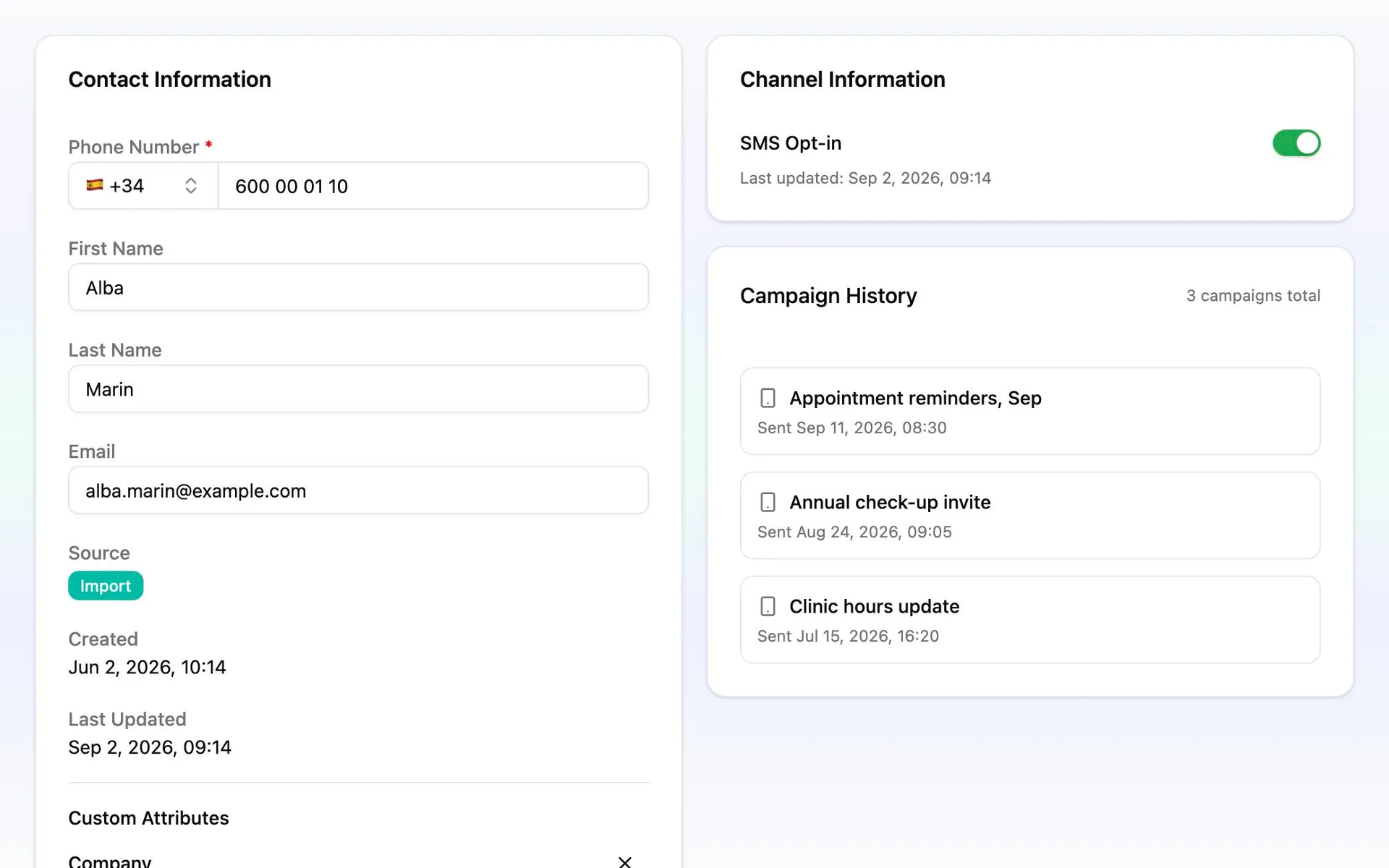
A clinic is asked who agreed to receive a message, to what, and when. Messalogy keeps that answer with the contact: every decision is recorded with its date and source, and earlier ones stay, so the record is a history, not a box someone last ticked.
Permission is checked again as each run goes out, so a patient who opts out on Tuesday is left out of Monday’s scheduled reminder, and no import quietly adds them back.
From the diary to a scheduled reminder
The first run takes an afternoon. In the ones after it, only the dates change.
Import the patients you already have
Bring in contacts with the fields the practice keeps: appointment date, practitioner, location, last visit. They become attributes you can build an audience on.
Record who agreed to what
Consent is held per contact with its history, and an opt-out arrives as an opt-out. Anyone who has left stays left, whichever list they turn up on next.
Build the audience from the date
A rule that follows the diary, not a list that ages in a folder. Audiences re-check themselves every time you send, so tomorrow’s reminders go to tomorrow’s bookings.
Review it, schedule it, follow it
Personalize with the patient’s own details, read the recipient list and the total back on the review screen, and pick the hour. Whether tomorrow’s reminders landed, and which patients to call instead, is in reporting.